


Small and medium-sized enterprises (SMEs) are the lifeblood of innovation in the UK. We’ve dived into the most recent SME statistics, exploring their contribution to the UK economy.
How many UK SMEs are there?
According to the government’s Business Population Estimates for the UK and Regions 2025 report, there are 5.69 million SMEs, which make up 99.85% of UK private sector businesses. 5.64 million of these are classed as “small” (0 to 49 employees) and 38,435 are classed as “medium-sized” (50 to 249 employees).
Drilling into the stats that come with the report, there are a further 4,290 businesses that could potentially be classed as SMEs for R&D Tax Credits purposes as they employ between 250 to 499 people (as long as they meet the rest of the criteria – see below).
What is the definition of an SME for R&D Tax Credits purposes?
While reporting the number of SMEs in the UK, the Department for Business, Energy & Industrial Strategy uses the basic criteria of between 0 to 49 employees for a small business and 50 to 249 employees for a medium-sized business.
For applying for R&D Tax Credits, the definition of an SME in the UK is more specific. For tax purposes, HMRC defines small and medium-sized enterprises as having a headcount below 500 and a turnover of under €100m, or a balance sheet that totals less than €86m.
Loss-making SMEs whose R&D spend makes up at least 30% of their total expenditure (for accounting periods beginning on or after 1 April 2024) are classed as “R&D intensive” and are therefore eligible for enhanced R&D intensive support. All other eligible SMEs would use the merged R&D scheme for claiming tax credits.
You can find out more by downloading our whitepaper: The Complete Guide To R&D Tax Credits.
How many people in the UK are employed by SMEs?
The government’s statistics show that in 2025 SMEs employed 16.9 million people in the UK, 60% of the total number of people employed by the private sector.
What is the turnover of SMEs in the UK?
The government reports that turnover for UK SMEs was £2.8 trillion in 2025, 51% of the total turnover of private businesses.
How many SMEs claimed R&D Tax Credits?
For the 2023-2024 tax year, HMRC estimates that 43,615 SMEs made R&D claims, 93% of all claims.
36,885 of these made SME scheme claims, which break down as:
- 16,020 claims for a deduction from Corporation Tax liability
- 20,865 claims for a payable tax credit
This includes 3,990 companies who qualified as R&D intensive.
As well as this, there were 6,730 SMEs that claimed under the RDEC scheme.
Where are SMEs conducting R&D in the UK?
For the 2023-24 tax year, 89% of businesses who made SME scheme R&D claims were from England. 3% were from Wales. 5% were from Scotland and 3% were from Northern Ireland.
24% of SME scheme claims came from London, 15% came from the South East and 9% came from the North West and another 10% from the East of England. The table below shows the number and percentage share of claims, broken down by region.
SME R&D Tax Credits scheme claims by region 2022-2023
| Region | Number of SME Scheme claims 2023–24 | % of SME scheme claims 2023–24 |
|---|---|---|
| North East (England) | 1,075 | 3% |
| North West (England) | 3,450 | 9% |
| Yorkshire and The Humber | 2,490 | 7% |
| East Midlands (England) | 2,245 | 6% |
| West Midlands (England) | 2,755 | 7% |
| East (England) | 3,625 | 10% |
| London | 8,900 | 24% |
| South East (England) | 5,380 | 15% |
| South West (England) | 2,780 | 8% |
| Wales | 1,140 | 3% |
| Scotland | 2,005 | 5% |
| Northern Ireland | 1,010 | 3% |
| Unknown | 35 | 0% |
| Total | 36,885 | 100% |
Which industries benefit the most from the SME Research and Development (R&D) scheme?
For the 2023-24 tax year, the majority of SME R&D Tax Credits scheme claims came from just three industries, including information & communication (28%), manufacturing (25%) and professional, scientific & technical (17%).
The table below shows the number and percentage share of SME scheme claims, broken down by industry.
SME R&D Tax Credits scheme claims by industry 2022-2023
| Industry sector | Number of SME Scheme claims 2023–24 | % of SME scheme claims 2023–24 |
|---|---|---|
| A. Agriculture, Forestry, Fishing | 835 | 2% |
| B. Mining & Quarrying | 110 | 0% |
| C. Manufacturing | 9,060 | 25% |
| D. Electricity, Gas, Steam and Air Conditioning | 105 | 0% |
| E. Water, Sewerage and Waste | 255 | 1% |
| F. Construction | 2,915 | 8% |
| G. Wholesale & Retail Trade, Repairs | 1,690 | 5% |
| H. Transport & Storage | 250 | 1% |
| I. Accommodation & Food | 135 | 0% |
| J. Information & Communication | 10,245 | 28% |
| K. Financial & Insurance | 575 | 2% |
| L. Real Estate | 95 | 0% |
| M. Professional, Scientific & Technical | 6,435 | 17% |
| N. Admin & Support Services | 2,315 | 6% |
| O. Public Admin, Defence & Social Services | 35 | 0% |
| P. Education | 200 | 1% |
| Q. Health & Social Work | 470 | 1% |
| R. Arts, Entertainment & Recreation | 400 | 1% |
| S. Other services activities | 685 | 2% |
| Other or unknown | 75 | 0% |
| Total | 36,885 | 100% |
How many SMEs are led by women?
According to the government’s Longitudinal Small Business Survey: SME Employers – UK, 2024, 40% of SMEs have women in significant leadership roles. This breaks down as:
- 14% of SMEs were women-led
- 26% of SMEs were ‘equally-led’, with the same number of men and women in management roles
As well as this:
- 10% of SMEs had a minority of women in management roles
- 43% of SMEs were entirely male led
- The remainder “didn’t know”
The industries most likely to be majority led by women are health/social work (35%), education (34%) and other services (20%), accommodation and food (19%) and professional and scientific (19%).
How many SMEs are minority ethnic group-led?
The government’s Small Business Survey reported that 6% of SMEs were led by a management team with at least half of its members from minority ethnic groups.
Is the number of SMEs in the UK declining?
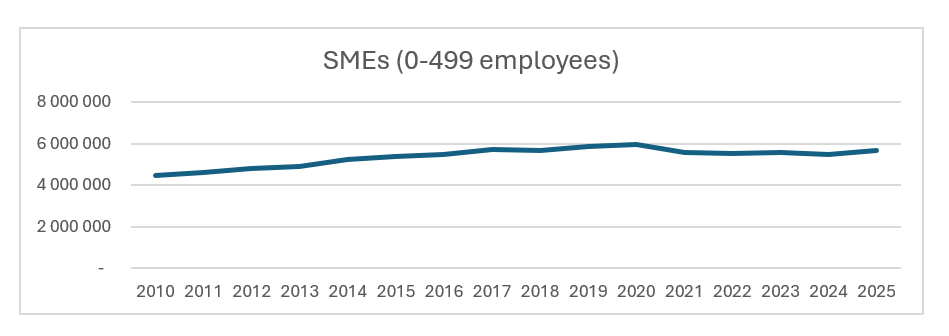
For nearly twenty years, there was sustained growth in the number of SMEs in the private sector with 0-499 employees; however, in recent years growth has been much more up and down.
According to the latest HMRC data, the number of SMEs fell from 5.59 million to 5.51 million between 2021 to 2022 but they grew to 5.55 million in 2023, dipped to 5.50 million in 2024, and then rose again to 5.69 million in 2025.
In the table below we show growth of UK SMEs in the private sector from 2010 to 2025.
SMEs in the private sector with 0-499 employees, UK 2010 to 2025
How many businesses are first-time applicants for the SME R&D Tax Credits scheme?
We don’t have the full data from HMRC for the 2023-24 tax year but we know that in the tax year 2022-23, there were 7,230 first-time SME scheme applicants , down from 13,155 in 2021-2022 (a 45% decrease).
The table below shows the number of first-time R&D Tax Credits claimants from 2000-01 to 2023-24.*
First-time SME scheme applications, 2000-01 to 2022-23
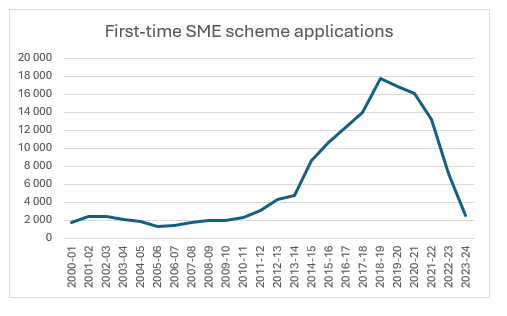
*Note: the number of first-time SME scheme applications for 2023-24 is only partial and will be revised by HMRC at a later date.
What do SMEs see as their main obstacles to growth?
In the 2024 Small Business Survey, SMEs reported the following obstacles to growth:
- Taxation, VAT, PAYE, National Insurance, business rates (61%)
- The level of energy prices (50%)
- Regulations/red tape (44%)
- Competition in the market (40%)
- Staff recruitment and skills (37%)
- UK exit from the EU (31%)
- National Living Wage (31%)
- Other issues relating to costs (31%)
- Late payment (26%)
- Availability/cost of suitable premises (17%)
- Obtaining finance (16%)
- Workplace pensions (12%)
How many SMEs use external finance?
The 2024 Small Business Survey reported that nearly three-quarters of SMEs (72%) use some form of external finance. This is down from 73% in 2023.
How are SMEs most likely to innovate through R&D?
According to the government’s 2024 Small Business Survey, in the last three years, 16% of SMEs invested in R&D, but only 7% applied for R&D Tax Credits.
If you enjoyed this article, you might also like: