
Don’t Get Caught Off Guard: Keep Your Sales Tax Exemptio...
Businesses operating in the United States should understand the sales and use tax compl...
Change your region and language
Be sure to pick the location that matches your preferences.


Biotech companies aim to create value by pushing the boundaries of science, developing new cures or offering more cost-effective treatments for pressing health issues. As these challenges grow in complexity and markets become increasingly global, international R&D has become the norm.
Maximizing innovation incentives across multiple tax regimes is critical to sustaining this progress.
This article explores how partnering with a global consultancy from the outset can unlock additional value for emerging Biotechnology companies.
In a previous article, we highlighted how important leveraging R&D credits was to promote Biotechnology innovation(1). As demonstrated in Figure 1, emerging biotech companies based in the United States are the major driver for innovation over large pharmaceutical companies(2,3), having submitted 33% more novel drug approvals to the FDA in 2024 and is trending the same way for 2025.
As a result, tax policy to encourage innovation in SME’s is a major concern for governments at all levels as these decisions have a major impact on companies working in their framework.
One of the most impactful examples is the removal of amortization over 5 years which passed in the OBBB bill over the summer of 2025(4,5). This creates an additional layer of complexity for senior executives in the Biotech industry as innovation no longer happens within the boundaries of a single city, state or country.
Biotech companies increasingly operate in multi-jurisdictional R&D ecosystems, where discovery and early scientific work may occur domestically, but are often faced with significant technical issues where collaborations with world experts become commonplace.
Moreover, clinical trials target key markets which typically include North America, Europe, Asia-Pacific, and Latin America as demonstrated in Figure 1 (6). This globalization gives companies access to diverse patient populations, faster recruitment, specialized expertise, and, in some cases, more favorable regulatory pathways
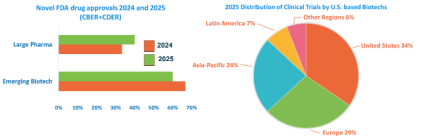
However, while global R&D accelerates scientific progress, it also brings significant tax complexity that many organizations underestimate. Tax authorities around the world have become far more assertive, more unified, and more data-driven(7). As a result, biotech companies that fail to correctly structure global R&D activities can face:
| Denied R&D tax credits | Unexpected permanent establishment assessments |
| Double taxation | Large penalties for misallocated expenses |
| Disputes over transfer pricing | Reputational risk from compliance failures |
Earlier this year, we highlighted the importance of R&D tax credits for early stage Life Science companies(8). This article makes the compelling case to leaders in the biotech industry that partnering with global tax consultancy firms early to in their life cycle, not only prevents tax burden risks but it can create additional value.
This table provides an overview of the main issues that Biotechs need to consider when conducting international R&D credits studies.
| Incompatible R&D Tax Incentive Rules Across Countries | Every country views international R&D differently: – The U.S. R&D credit allows some international work within subsidiaries but imposes strict requirements to demonstrate financial risk and rights to results. – Canada’s SR&ED program generally restricts incentives to R&D performed physically in Canada – The U.K. and Australia R&D scheme allows claims for some overseas activities only under specific “qualifying overseas expenditure” rules – Typically, EU countries will only provide partial credits for R&D work done within the EU with incentives to conduct the work locally. |
| Transfer Pricing & Intercompany Agreements | Intercompany agreements need to be structured correctly especially when R&D is performed across borders. For example, a U.S. parent company funds a clinical trial performed by a EU subsidiary. It needs to be clearly documented, which entity owns the IP, and is funding, directing and bears the scientific and financial risk for the the work. If the document is not done correctly, local authorities can: Deny deductions, challenge R&D credit claims, and impose transfer pricing penalties. |
| Risk of Double Taxation | Double taxation arises when two jurisdictions claim rights to tax the same income or deny the same deduction. For example, a U.S. based Biotech company is paying substancial clinical trial fees in Spain, however the spanish authorities deny R&D incentives because the company is not registered in Spain. Meanwhile the U.S. authorities deny R&D credits because the work was done abroad. The company ends up with zero deductions or credits. |
| Permanent Establishment | In a case where a U.S. company conducts a very large or repeated clinical trials with a CRO in a foreign country. The authorities in that country may claim that the U.S. company is effectively established locally and therefore should be subject to paying local taxes. |
Creating incentives for innovation is one of the key concerns for all levels of government who are reviewing their tax policies on a regular basis in response to a host of factors that are out of a Biotech company’s control. This creates a situation where there is a lot of confusion & misinformation regarding what the best strategy would be when planning R&D work in multiple jurisdictions.
For instance, a Phase II trial conducted in three different countries may qualify for full incentives in one country. For partial incentives in another and no incentives in a third.
Meanwhile, the home country may not allow deductions or credits for costs incurred abroad. Especially if the contracts with CRO’s or foreign subsidiaries are not structured correctly. This creates lost opportunities and compliance risks.
By working with Leyton, a global tax consultancy firm, you benefit from having a partner that can understand your global commercialization strategy. But also local knowledge that boils down to the municipal level in order to maximize R&D tax incentives and avoid risks such as double taxing, intercompany agreement confusion, and permanent establishment.
Moreover, consultants think outside the box given that the firm offers a complete list of services designed to maximize tax incentives in areas other than R&D.
This could include energy optimization incentives, property taxes and cost segregation for companies that may have full or partial ownership of a foreign subsidiary.
As Biotech companies continue to globalize, scientific strategy and tax strategy must evolve together. R&D leaders increasingly recognize that tax incentives are not simply a compliance obligation, they are a funding mechanism.
In a cash-intensive industry, leaving credits unclaimed or exposing the company to unnecessary tax risk can materially affect runway, valuation, and future opportunities.
A global consultancy such as Leyton provides:
In a world where one misaligned contract, misunderstood rule or unsupported claim can cost millions, global R&D tax coordination is not merely an administrative function, it is a strategic advantage.

Explore our latest insights
See more arrow_forward
Businesses operating in the United States should understand the sales and use tax compl...

If your business sells machinery, equipment or other goods that require installation or assembly ...

The life sciences sector is uniquely capital-intensive, highly regulated, and driven by continuou...

Internal Use Software (IUS) remains one of the most misunderstood and frequently misapplied areas...