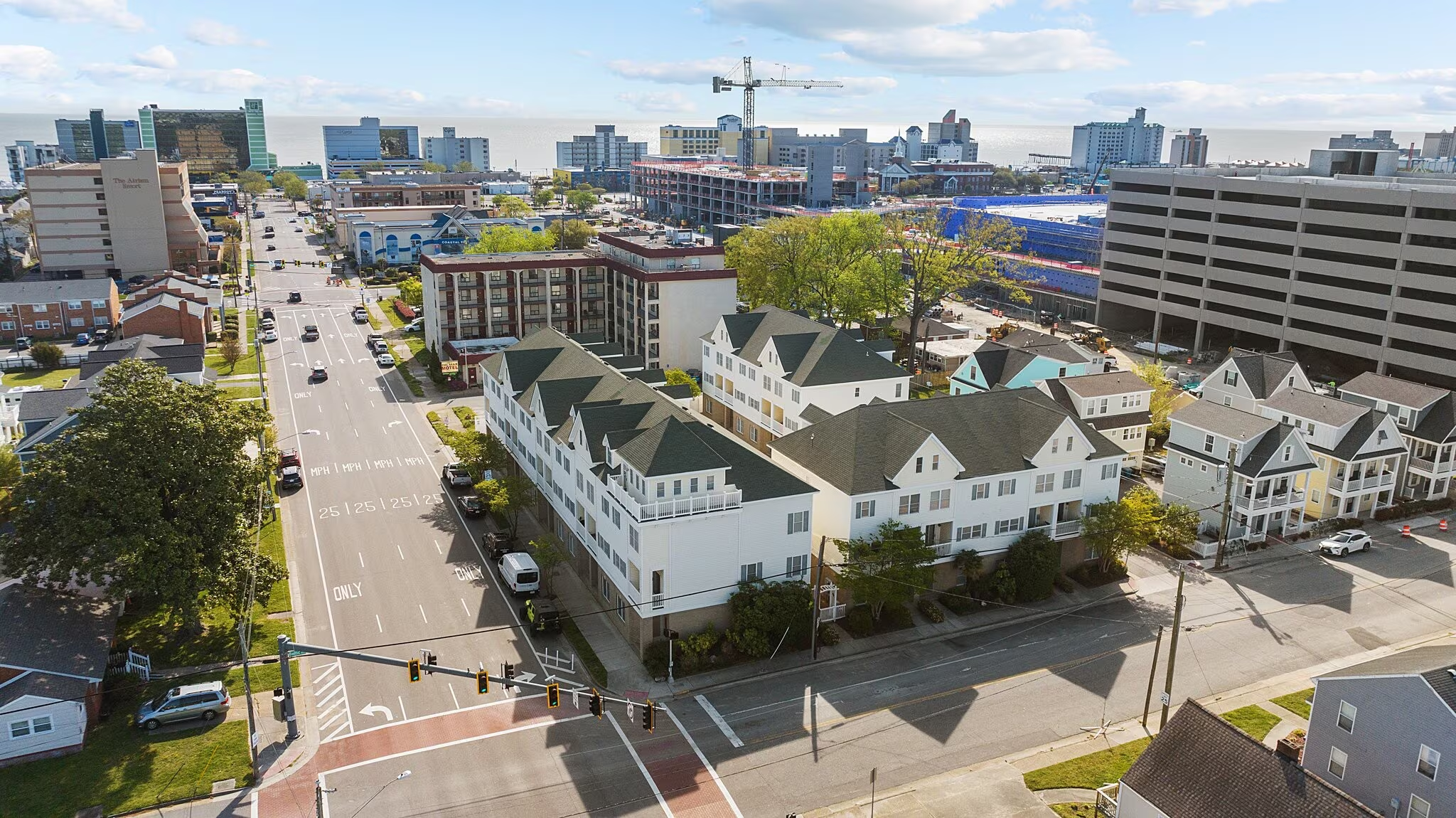
Real estate investors often have questions about how Cost Segregation Real Estate strategies apply to their specific property type. Below are some of the most common questions we receive from clients, along with how our consultants address them. We continue to add new Cost Segregation Real Estate scenarios as new situations arise.
An engineering-based study is prepared by specialists who analyze the property’s construction components, costs, and tax classifications in detail. These studies rely on engineering methods, cost estimation, and IRS guidelines to properly allocate assets to shorter depreciation lives.
DIY tools or rapid reports typically use rule-of-thumb estimates or calculators, which may not fully analyze the building’s components. Because cost segregation involves many technical judgments and tax nuances, each property can be different.
A professionally prepared engineering study is generally considered defensible if the IRS reviews the depreciation in later years, which is when audits typically occur.

Placed in Service Year: 2024
Use Type: Short-Term Rental (Airbnb)
If a property owner refinances a construction loan, but the ownership and entity remain the same, is a new cost segregation study required?
No. A refinance does not require a new cost segregation study. Cost segregation is tied to the property acquisition or ownership change, not how the property is financed. If the owner and entity remain the same, the original study continues to apply.
Placed in Service Year: Unit 1 – 2023, Unit 2 – 2024
Use Type: Short-Term Rental (Airbnb)
A duplex was purchased in 2021 and initially used as a personal residence. In 2023, one unit was listed on Airbnb and placed into service as a rental. In 2024, the second unit was also converted to a rental after the tenant moved out.
For cost segregation purposes, does each unit receive its own placed-in-service date and depreciation treatment, or can the entire property be treated as one asset?
Each unit generally follows its own placed-in-service date based on when it began operating as a rental. In this cost segregation real estate scenario, one unit would be placed in service in 2023 and the second in 2024.
A cost segregation study can still analyze the entire duplex, but the results are typically split into two depreciable assets so each unit follows the correct depreciation and bonus depreciation rules. Taxpayers should consult their CPA regarding how these deductions apply to their specific tax situation.
Placed in Service Year: 2025
Use Type: Recreational / Commercial Property
A 9-hole golf course was purchased in 2025 with no major renovations. The property was essentially “plug and play” with existing operations. For a cost segregation study, would only the clubhouse qualify, or are there other components of a golf course that can be reclassified?
A cost segregation study can include more than just the clubhouse. In cost segregation real estate for golf courses, many land improvements may qualify for accelerated depreciation, such as irrigation systems, drainage systems, cart paths, bunkers, landscaping, lighting, and fencing.
Natural elements like existing land or trees are generally not depreciable, but constructed features and installed systems may be eligible. A closing statement and basic property details are typically enough to provide an initial estimate.
Placed in Service Year: 2026
Use Type: Investment / Rental Property
For a property acquired through a 1031 exchange, should the prior property’s depreciation schedule be reviewed before performing a cost segregation study?
Yes, reviewing the prior depreciation schedule is helpful, especially if the exchanged property was placed in service in a prior year. This allows the remaining depreciation basis to be properly analyzed.
If the exchange occurred in the current year, the closing statement for the replacement property is typically sufficient to determine the new 1031 basis for the cost segregation study.
Placed in Service Year: 2025
Use Type: Rental / Investment Property
A real estate investor originally acted as the lender on a home and later assumed ownership of the property in July 2025, with a formal transfer of title. The original purchase price of the home was around $250,000, but the new owner estimates the value at $310,000 after legal fees and other costs.
Would this situation count as a new acquisition for cost segregation purposes, and how is the property’s basis determined?
Yes, if the title or deed was formally transferred, it is generally treated as an acquisition for cost segregation purposes, regardless of how the property was financed.
The basis is typically determined by the agreed purchase price in the transfer agreement, plus certain acquisition-related costs such as legal or closing fees. Documentation showing the contract price or settlement details will usually be needed to establish the depreciable basis.
Placed in Service Year: 2025
Use Type: Short-Term Rental / Mixed Personal Use
A property owner purchased a $1M home in 2025 and primarily lives there but occasionally rents it out as a vacation rental. If the owner decides to treat the property as a rental, would it qualify for a cost segregation study?
It depends on the personal use vs. rental use of the property. If the owner uses the home for more than 14 days per year (or more than 10% of the total days it is rented), the IRS generally considers it a second home rather than an investment property.
If the property qualifies as a rental or short-term rental investment, a cost segregation study may be possible. The owner should confirm their personal use and rental days with their CPA to determine eligibility.
Placed in Service Year: 2025
Use Type: Operating Business + Separate Real Estate Holding Company
A wedding venue building is owned by one LLC that holds the real estate, while a separate LLC operates the wedding venue business and leases the building from the holding company. The rent charged is roughly equal to the mortgage payment.
If a cost segregation study creates additional depreciation, can those losses offset income from the operating wedding venue business?
This structure is common, where one LLC owns the real estate and another operates the business. In this case, the depreciation from the real estate entity is typically treated as passive rental activity.
Because the real estate and operating business are in separate entities, the depreciation losses usually cannot offset the active business income unless the owner qualifies as a Real Estate Professional (REPS) or has other passive income to offset the losses. A CPA should review the structure to determine the potential tax benefit.
Placed in Service Year: 2026 (planned)
Use Type: Commercial / Investment Property
If a commercial property is purchased in 2025 but is not placed into service until renovations are completed in June 2026, should the owner perform one cost segregation study in 2026, or separate studies for the purchase and renovation?
If the property was not placed in service in 2025, depreciation cannot begin yet. In that case, both the purchase and renovation costs are typically analyzed together once the property is placed in service in 2026.
A cost segregation study would usually include the building purchase price (excluding land) plus renovation costs. If the renovations include qualifying interior improvements, QIP rules may also apply, which can potentially increase the accelerated depreciation benefit.
Solar system installation year: 2025
Use Type: Energy Improvement (Solar / ITC Eligible)
Can a cost segregation study be performed for solar installations to support the Investment Tax Credit (ITC), and how is the pricing structured for this type of study?
Yes. A cost segregation study can help identify and allocate the components of a solar installation that qualify for the Investment Tax Credit (ITC).
The pricing is generally the same as a standard cost segregation study. The study identifies the solar-related equipment and components, and the taxpayer or their CPA can then use that information to claim the ITC credit on the qualifying assets.
Placed in Service Year: 2025
Use Type: Long-Term Rental
A property was purchased in 2022, used as a primary residence, and later renovated. Total investment is $645,491 including $72,000 for land. Renovations were completed in 2025, and the property began renting in August 2025 under an LLC.
When preparing a cost segregation estimate, what costs should be requested, and when does depreciation begin?
The clearest information to request is the original purchase price and a breakdown of the renovation costs. These amounts together generally determine the depreciable building basis (excluding land).
Because the property was originally a personal residence, depreciation would typically start when the home was first placed in service as a rental in 2025. The earlier purchase date does not trigger depreciation if the property was not used as an investment property at that time.
Placed in Service Year: 2025
Use Type: Long-Term Rental
A property owner completed renovations and began renting the property in 2025. Whether the renovation costs could qualify for 100% accelerated depreciation, rather than combining the renovation with the building basis and accelerating only a portion through a cost segregation study?
Some renovation costs may qualify for accelerated depreciation, but not all improvements are eligible. In general, interior, non-structural work-such as paint, flooring, drywall, electrical, and plumbing-may qualify for faster depreciation. Improvements that affect the exterior or structure of the building-such as roofs, windows, doors, or exterior walls-typically do not.
If the property also involves a recent acquisition, a cost segregation study is often used to properly allocate both the purchase price and renovation costs. A detailed breakdown of renovation expenses helps determine what portion may qualify.
Placed in Service Year: 2026
Use Type: Commercial Investment
Can a cost segregation study be used for state tax filings, or is it only applicable to federal tax returns?
For example, would a property owner in Oregon be able to apply the results of a cost segregation study at the state level?
The same Cost Segregation Real Estate study is typically used for both federal and state tax returns. However, within Cost Segregation Real Estate, individual states may have different rules regarding bonus depreciation or depreciation adjustments, which can affect how the results of a Cost Segregation Real Estate study are applied at the state level.
The study itself does not change-the CPA applies the state-specific rules when preparing the tax return.
Our team of Cost Segregation Experts includes dedicated Professional Engineers and tax specialists focused on helping property owners unlock accelerated depreciation benefits. Having completed over 10,000 residential and commercial studies nationwide, we follow established IRS guidance and engineering-based methodologies to provide precise and compliant cost segregation study.

Cedric James
Senior Project Manager
William Wightman
Senior Cost Segregation Study Consultant
Andrea Gracia
Project Manager
Omar Al Fezghari
Senior Building Energy Efficiency Consultant
We help companies unlock millions in funding through R&D tax credits, energy incentives, state, and local tax programs. Our experts partner with finance and executive teams to identify overlooked opportunities, improve cash flow, optimize tax positions to reinvest savings into innovation and sustainable growth.
In Tax relief
Industries Served
Years of Experience
Tax & Technical Experts