
Don’t Get Caught Off Guard: Keep Your Sales Tax Exemptio...
Businesses operating in the United States should understand the sales and use tax compl...
Change your region and language
Be sure to pick the location that matches your preferences.


Are you planning to hire more cloud infrastructure engineers? The average salary ranges from $134,627 to $160,000+ annually, a significant investment. What many businesses don’t realize: your cloud work likely qualifies for substantial R&D tax credits and payroll tax offsets that can directly fund this hiring.
Leyton helps companies across SaaS, gaming, healthcare, manufacturing, and app development recover some of the engineering costs through federal and state tax incentives. Before we explore how to find and hire the right cloud infrastructure engineer, let’s understand what makes cloud infrastructure such a valuable and fundable investment.
It refers to the hardware and software components needed to support cloud computing. This includes servers, storage systems, networking equipment, and virtualization software, all hosted by providers like Amazon Web Services (AWS), Microsoft Azure, or Google Cloud Platform (GCP).
Unlike traditional on-premises infrastructure, cloud exists virtually. Companies access computing resources over the internet rather than maintaining physical data centers. This model provides:
For businesses in app development, SaaS, gaming, healthcare, and manufacturing, cloud infrastructure enables rapid innovation without massive capital investment in physical hardware.
It operates through three primary service models:
Infrastructure as a Service (IaaS): Provides virtualized computing resources over the internet. Companies rent servers, storage, and networking from providers like AWS EC2, Azure Virtual Machines, or Google Compute Engine. You manage the operating systems, applications, and data while the provider handles physical infrastructure.
Platform as a Service (PaaS): Offers a development environment where engineers build, test, and deploy applications without managing underlying infrastructure. Examples include AWS Elastic Beanstalk, Azure App Services, and Google App Engine. PaaS is particularly popular for SaaS companies and app developers.
Software as a Service (SaaS): Delivers complete applications over the internet. While end-users consume SaaS products, SaaS companies themselves rely heavily on IaaS and PaaS cloud infrastructure to host and deliver their services.
Compute Resources: Virtual machines, containers, and serverless functions that execute application code. AWS offers EC2 instances, Azure provides Virtual Machines, and GCP delivers Compute Engine instances.
Storage Systems: Object storage (AWS S3, Azure Blob Storage, Google Cloud Storage), block storage for databases, and file storage for shared access.
Networking: Virtual private clouds (VPCs), load balancers, content delivery networks (CDNs), and DNS services that connect users to applications globally.
Security: Identity and access management (IAM), encryption, firewalls and compliance tools that protect data and meet regulatory requirements, critical for healthcare and financial services.
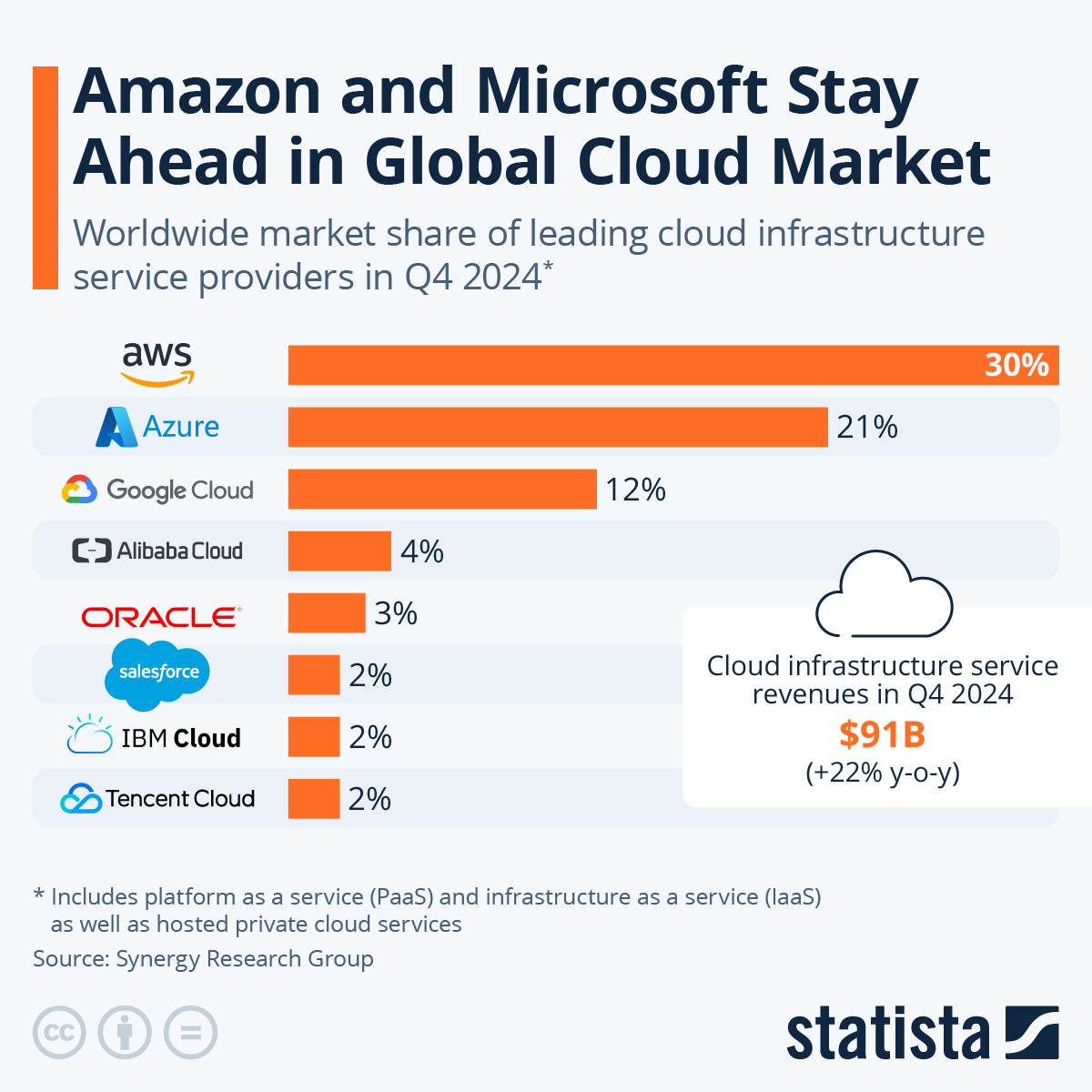 You will find more infographics at Statista
 The “best” cloud provider depends on your specific needs, but three providers dominate the market:
Cloud infrastructure engineers design, implement, and maintain cloud-based systems. Their responsibilities span:
Understanding market rates helps you budget for hiring and evaluate R&D tax credit potential.
Cloud Infrastructure Engineer: $119,928 median annual salary, ranging from $134,627 to $147,429
Cloud Engineer (broader role): $134,821 average according to Indeed, based on 3,400 reported salaries in the past 36 months (updated on October 13th, 2025)
Senior Cloud Infrastructure Engineer: Exceed $160,000+
Hourly rates: $58/hour median for cloud infrastructure engineers
Finding the right cloud infrastructure talent requires strategic approach:
Project scope: Are you migrating to cloud, optimizing existing infrastructure, or building new systems?
Platform requirements: AWS, Azure, GCP, or multi-cloud? Your choice affects candidate pool.
Seniority level:
Industry experience: Healthcare, SaaS, gaming, and manufacturing have unique requirements
Required skills (must-have):
Preferred skills (nice-to-have):
Realistic responsibilities: Describe actual projects, not generic duties
Compensation transparency: Listing salary ranges attracts 30% more qualified applicants
Are you planning to hire more cloud infrastructure engineers? The investment may be more affordable than you realize.
Here’s what many CEOs and CFOs miss: migrating to cloud infrastructure or optimizing cloud systems often qualifies for R&D tax credits, even if you’re not developing entirely new technology.
If your company is:
Your cloud engineering work likely qualifies for R&D tax credits.
Contact Leyton today for a complimentary assessment of your R&D tax credit potential. Our team will review your cloud projects, identify qualifying activities, and estimate your available credits!

Explore our latest insights
See more arrow_forward
Businesses operating in the United States should understand the sales and use tax compl...

If your business sells machinery, equipment or other goods that require installation or assembly ...

The life sciences sector is uniquely capital-intensive, highly regulated, and driven by continuou...

Internal Use Software (IUS) remains one of the most misunderstood and frequently misapplied areas...